
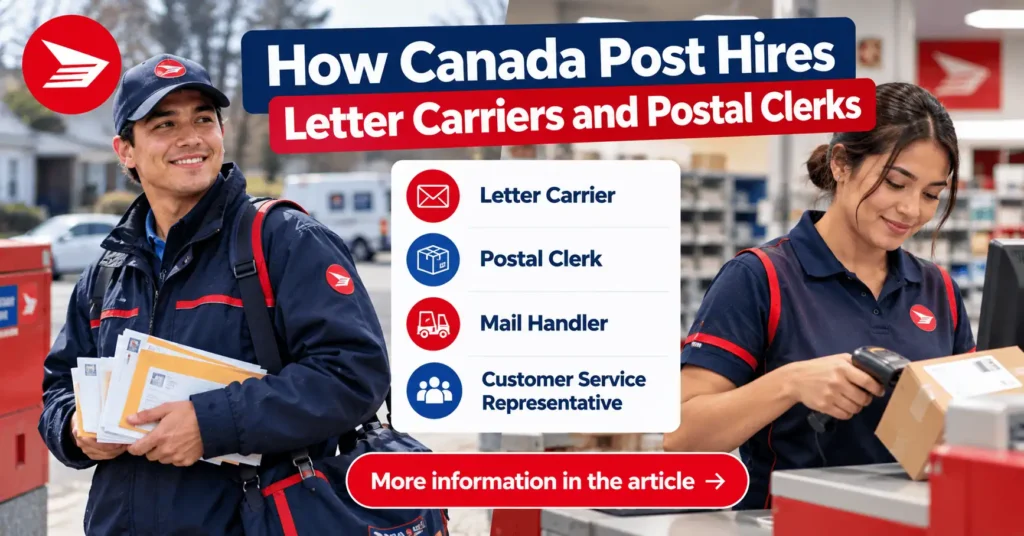
A parcel dropped at a post office in Halifax can reach a doorstep in Calgary within days. Behind that trip are thousands of workers in plants and depots, and many of them started in Canada Post jobs with no experience.
The two main entry roles are letter carrier, also called delivery agent, and postal clerk, the person who sorts mail inside processing plants.
This guide follows a parcel through the network to explain both jobs, their hourly pay and how the hiring process works.
The journey of a parcel, and who handles it
1 · Counter
Accepted at a post office
2 · Plant
Sorted by postal clerks
3 · Depot
Prepared for each route
4 · Door
Delivered by a letter carrier
Each step has its own entry jobs. Counter work is done by post office assistants and retail postal clerks, plants hire postal clerks, and depots and routes depend on delivery agents.
Letter carrier (delivery agent)
Official Canada Post postings describe the day like this: you start in the depot sorting and preparing deliveries, load and drive a postal vehicle, spend most of the day outside delivering mail and parcels by foot or by vehicle, and return to the depot to unload incoming items for later delivery.
Requirements listed in recent postings include:
- A valid Class 5 or Class G driver’s licence with a safe driving record for at least three years, with a driver’s abstract.
- The physical ability to lift mail items of up to 22.7 kg (50 lb) and carry items of up to 15.9 kg (35 lb) regularly throughout the day.
- The ability to work in all types of weather.
- Availability for on-call work.
One Quebec City posting was even more specific: routes can mean 20 to 25 km of walking in any weather, with stairs and snow, and replacements may be called on short notice between 8 a.m. and 8 p.m. from Monday to Friday.
Postal clerk in a processing plant
Postal clerks keep the mail moving inside the plants. According to Canada Post postings, they receive, sort, scan, sequence and batch mail, operate mail-processing equipment, transfer and load postal trucks, dispatch parcels and complete reports. Some roles also involve operating material handling equipment or moving corporate vehicles, which requires a valid licence and a safe driving record.
Plant postings often say that no experience is necessary, although work in a production or warehouse environment is an asset. Shifts can include days, evenings, nights and weekends, and some postings mention standing in one place for up to three and a half hours at a time.
What the jobs pay
| Role | Example location | Hourly pay |
|---|---|---|
| Letter carrier – delivery agent | Quebec City, Terrace (BC), Winnipeg | $23.81 |
| Postal clerk – plant | Saint-Laurent (QC), Richmond (BC), Toronto | $23.81 |
| Post office assistant – term | Rural offices in SK, QC and YT | $20.54 |
These are the starting rates shown in 2026 postings on the official careers site and job boards. Postings also mention classroom and on-the-job training and opportunities for permanent employment.
«On call» and «temporary»: what they mean here
Almost every entry position at Canada Post starts as temporary and on call. Postings state clearly that there are no guaranteed hours: you are called when a regular employee is absent or when volume increases. Some plants also hire for fixed holiday periods, such as a past Richmond posting for postal clerks from November 15 to January 15.
This model has two sides. On one hand, income can be irregular at first, so it works best as a first job, a second job or for people with flexible schedules. On the other hand, it is the main door into the company, and Canada Post says it likes to promote from within, with access to permanent positions for workers who prove reliable.
How the hiring process works
- Find a posting on the official careers site and check the language requirement. Some positions require English, others French, and some are bilingual.
- Apply online and make sure your application clearly shows how you meet each requirement, because postings warn that Canada Post cannot make assumptions about your experience.
- Complete pre-employment assessments if you are selected. Postings mention that assessments and training may take place in outside facilities.
- Attend training, which mixes classroom sessions with on-the-job learning about duties and safety.
- Stay available. Once you are on the on-call list, answering calls quickly is what brings more hours.
Several postings note that failing to respond or attend scheduled steps is treated as a withdrawal of your application, so keep your phone and email close during the process.
Employment equity and accommodation
Some Canada Post postings are part of special measures that give preference to Indigenous people or persons with disabilities, who must self-identify to be considered under that measure. The company also invites applicants to tell recruiters about any accommodation they need during the hiring process, and says this information is kept confidential.
Which role suits you?
Choose letter carrier if…
You enjoy being outdoors, walking long distances, meeting people and you have a clean driving record of at least three years.
Choose postal clerk if…
You prefer working indoors with a team, can handle evening or night shifts and like a steady production rhythm.
Practical tips before you apply
- Order your driver’s abstract early if you apply for delivery, since postings require it.
- Prepare for winter. Delivery agents work in every season, so good boots, layers and gloves are part of the job.
- Set up job alerts on the careers site. Positions open in waves, and alerts help you apply before they close.
- Be honest about your availability. On-call lists work best when the hours you offer are the hours you can really accept, and reliable answers lead to more calls.
- Apply in more than one area if you can travel, since vacancies differ widely between cities and plants.
Official careers website
Canada Post delivery, plant and retail jobs
You will be redirected to the company’s official website.
This site is an independent guide and is not affiliated with Canada Post. Positions, pay and requirements are set by the employer and may change.