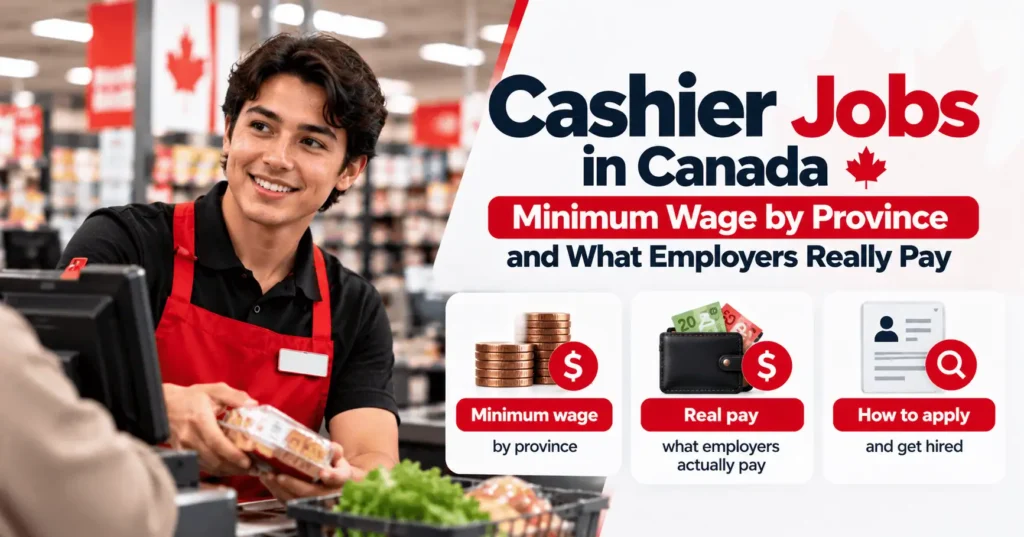
A cashier in Golden, British Columbia and a cashier in Corner Brook, Newfoundland do almost the same job. In 2026 one posting paid $2.25 more per hour than the other.
That gap is not luck. It comes from provincial minimum wages, local demand and the type of store doing the hiring.
This guide shows the current minimum wage by province, what real cashier jobs in Canada pay above it and how to use free government data to judge any offer.
What a cashier does in Canada
In the national job classification, cashiers fall under NOC 65100. The title covers supermarket checkouts, gas station counters, pharmacies, convenience stores, cinemas and big retail chains. The core tasks are similar everywhere: scanning items, taking cash and card payments, processing returns and exchanges, balancing the cash drawer at the end of a shift and answering basic questions about products and promotions.
Many employers add extra duties. At a gas station, the cashier often restocks coolers, cleans the store and handles lottery sales. In a supermarket, the cashier may bag groceries and help at self-checkout. In a big-box store, a cashier is often trained to work in other departments when the front end is quiet. Reading the duties in each posting tells you how physical and how busy the job will be.
Key points
✔ Every province sets its own minimum wage, and several changed on October 1, 2026.
✔ Alberta now has the lowest general rate in Canada, at $15.00.
✔ Job Bank publishes the median cashier wage for each region for free.
✔ Most cashier jobs need no diploma, only reliability and basic math.
Minimum wage by province (October 2026)
The minimum wage is the floor. No employer can legally pay a general worker less, although some provinces have separate rules for specific jobs. Five provinces raised their rate on October 1, 2026: Manitoba, Nova Scotia, Ontario, Prince Edward Island and Saskatchewan. Alberta has not changed its rate since 2019.
| Province / territory | General minimum wage | In effect since |
|---|---|---|
| Nunavut | $20.17 | Sep 1, 2026 |
| Yukon | $18.51 | Apr 1, 2026 |
| British Columbia | $18.25 | Jun 1, 2026 |
| Ontario | $17.95 | Oct 1, 2026 |
| Prince Edward Island | $17.30 | Oct 1, 2026 |
| Northwest Territories | $17.20 | Sep 1, 2026 |
| Nova Scotia | $17.00 | Oct 1, 2026 |
| Quebec | $16.60 | May 1, 2026 |
| Manitoba | $16.40 | Oct 1, 2026 |
| New Brunswick | $15.90 | Apr 1, 2026 |
| Saskatchewan | $15.70 | Oct 1, 2026 |
| Alberta | $15.00 | Jun 26, 2019 |
Newfoundland and Labrador also sets its own rate; check the provincial government website for the current figure. Remember that rates usually change once a year, often on April 1 or October 1, so an offer that was above the minimum in spring can be at the minimum by autumn.
What real cashier postings paid in 2026
Here are examples from 2026 postings, compared with the Job Bank median wage for cashiers in the same region:
- Golden, BC (gas station, full time, July 2026): $18.75 per hour for 40 hours a week. The median for cashiers in the Thompson–Okanagan region was $18.25.
- Corner Brook, NL (gas station, full time, August 2026): $16.50 per hour. The regional median was $16.35.
- Surrey, BC (big-box retailer, full time, May 2026): from $18 per hour.
The pattern is clear: most cashier offers sit a little above the local minimum, and close to the regional median. An offer well above the median usually means the job has extra duties, unusual hours such as overnight shifts, or a remote location.
How to use Job Bank wage data before you apply
Job Bank, the Government of Canada’s free job board, adds a «Job market information» box to many postings. It shows the median hourly wage for that occupation in that economic region. You can also search an occupation directly and see low, median and high wages by region. Use this data in three ways:
- To compare offers: if two stores offer different wages for the same title, the median tells you which one is closer to the local market.
- To negotiate: if you have cash handling experience, you can mention that the regional median is higher than the offer and ask whether experience is considered.
- To plan a move: if you are deciding where to settle, compare medians and minimum wages with local rent costs, not only the hourly rate.
Skills that make a cashier stand out
Employers rarely ask for a diploma, but they look closely at a few skills. Accuracy with money is the first one: a drawer that balances at the end of each shift builds trust quickly. Speed at the till matters in supermarkets and gas stations during rush hours. Friendly communication is just as important, because cashiers are often the only staff member a customer speaks to. A second language is a plus in many Canadian cities, and in Quebec and parts of New Brunswick, Ontario and Manitoba, French can be a strong advantage.
Knowing how to handle a difficult customer calmly, how to spot counterfeit bills and how to follow age-verification rules for products like lottery tickets, tobacco or alcohol will also help you in interviews.
Your rights as a cashier
Provincial employment standards protect cashiers like any other worker. In general, employers must pay at least the minimum wage, give rest or meal breaks according to provincial rules, pay overtime after a set number of hours and give you a pay statement. Rules about cash shortages differ by province, so if an employer wants to deduct missing money from your pay, check your province’s employment standards website before agreeing. If something seems wrong, the provincial employment standards office can answer questions for free.
Where to find cashier jobs
Start with Job Bank, which lets you filter by city, hours and date posted, and shows wages on almost every posting. Large chains also post on their own careers sites, and provincial boards such as SaskJobs, ALIS in Alberta or WorkBC list local openings. When you find a job you like, read the full posting, check the wage against the table above and apply quickly, since cashier positions are often filled within a few weeks.
Government of Canada
Search cashier jobs and wages on Job Bank
You will be redirected to the official Job Bank website.
This site is an independent guide. Minimum wages and job postings change over time; always confirm current rates with your provincial government before accepting an offer.