
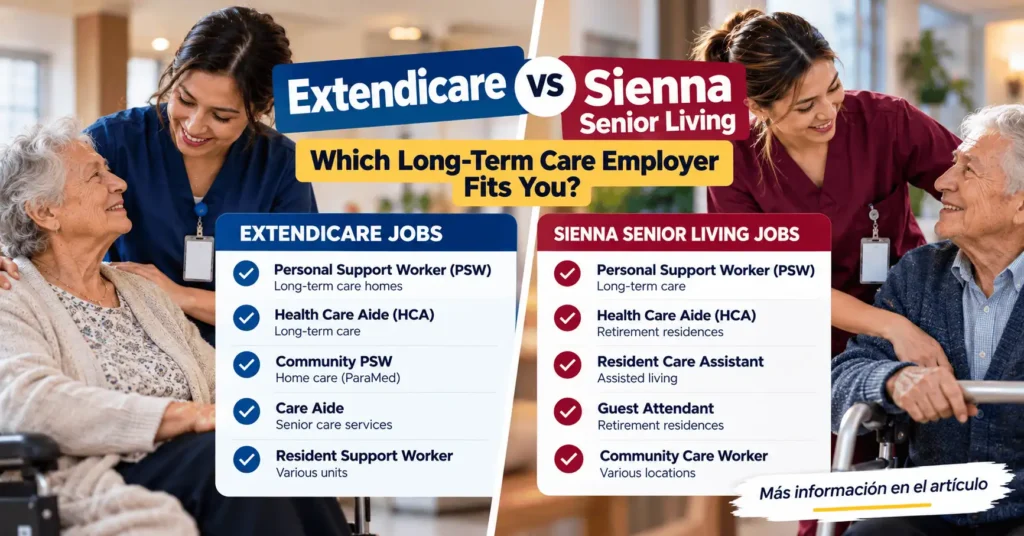
Two names appear again and again in long-term care jobs in Canada: Extendicare and Sienna Senior Living. Both hire personal support workers all year.
⏰Recommended read · PSW careerWhat a Personal Support Worker Really Does in a 12-Hour ShiftFollow a real shift hour by hour, with official PSW wages and the documents employers ask for.Read now →
Yet the day-to-day work, the provinces and the career paths are not the same. Choosing the right senior care employer can shape your first years as a PSW.
This side-by-side comparison of Extendicare jobs and Sienna Senior Living jobs uses information from their own postings and company reports.
The two employers at a glance
| Extendicare | Sienna Senior Living | |
|---|---|---|
| Main settings | Long-term care homes and home health care | Long-term care and private-pay retirement residences |
| Related brands | ParaMed (home care), Extendicare Assist, SGP Purchasing Network | Aspira (retirement living) |
| Where they operate | Homes across Canada, with a strong presence in Ontario | Ontario, British Columbia, Saskatchewan and Alberta |
| Workforce | One of Canada’s largest senior care employers | About 15,000 team members (2025 company report) |
| Experience | More than 50 years in senior care | Nearly five decades in seniors’ residences |
How the shifts are organized
Both companies hire for day, evening and night coverage, and most entry positions start as part-time or casual. The details in real postings show what to expect:
- Extendicare Laurier Manor (Ottawa): a 242-bed home listing part-time PSW shifts with evenings from 14:30 to 22:30 and nights from 22:30 to 6:30.
- Extendicare St. Catharines: a temporary part-time posting for 30 hours every two weeks, from 6 a.m. to 2 p.m.
- Aspira Waterford Barrie (Sienna): separate temporary part-time PSW postings for day and evening blocks in a retirement residence.
Casual work means you are called in to cover open shifts. It is the most common door into both companies, and many PSWs use it to learn several units before applying for a permanent line.
What each one asks of a new PSW
Extendicare postings
- PSW program, or a provincial equivalent with at least 600 hours of theory and practicum in Ontario and Alberta
- Current Basic Cardiac Life Support and First Aid
- Vulnerable Sector Check issued within the last three months
- Experience with dementia and palliative care preferred
- Ability to read, write and communicate in English
Sienna and Aspira postings
- PSW or Health Care Aide credential, depending on the province
- Some retirement residences combine PSW, HCA and Guest Attendant hiring in one posting
- Criminal records check, with a prescribed check for British Columbia applicants
- Comfort with residents who are more independent and social
Long-term care or retirement residence?
This is the real difference between the two employers. In long-term care, residents usually need help with most daily activities, many live with dementia, and care follows strict provincial standards. The pace is intense and the clinical learning is fast.
In a retirement residence, many residents are mobile and pay privately for services. PSWs still help with bathing, dressing and medication reminders, but the setting feels closer to a community, with dining rooms, events and more social time. Sienna offers both settings, so you can move between them as your interests change.
How to read a long-term care job posting
Postings from both employers use terms that can confuse new applicants. Knowing them helps you pick the right offer:
- Casual: no guaranteed hours. You are offered shifts when someone is sick, on vacation or when extra staff is needed. It is flexible, but your income can change from week to week.
- Temporary part-time: a set number of hours for a limited period, often to cover a leave. One Extendicare posting, for example, offered 30 hours every two weeks on a fixed early shift.
- Regular part-time or full-time: a permanent position with scheduled hours and, in many homes, access to benefits.
- Shift codes: some homes add short codes to the title to show the unit, the shift and the rotation. If a code is unclear, ask the recruiter what it means before the interview.
New homes mean new openings
Both companies are building or rebuilding homes, which creates hiring waves months before opening day:
- Extendicare is hiring for Forest Trail, a new long-term care home in Peterborough planned to open in the fourth quarter of 2026. New staff start casual at the current Peterborough home and transfer later.
- Extendicare also posted PSW roles that begin at Carlingview Manor and move to the new Beauclaire home.
- Sienna’s development projects include a campus of care in Brantford, Ontario (Aspira Brants Landing and Oakwood Commons) as part of its Ontario long-term care redevelopment.
Joining before a new home opens often gives you better choice of shifts, since the full schedule is still being built.
Questions to ask before you accept an offer
A short conversation with the hiring manager can save you months of frustration. Consider asking:
- How many residents will I usually support on each shift, and how many PSWs work on the unit?
- What does orientation include, and how many buddy shifts will I have before working on my own?
- How often are weekends and holidays scheduled for my position?
- Is there a path from casual to part-time or full-time, and how are those positions offered?
- Which benefits apply to my type of position, and when do they start?
Which one fits you?
Lean toward Extendicare if… you want deep long-term care experience and the option to move into home care later through its ParaMed brand.
Lean toward Sienna if… you live in British Columbia, Saskatchewan or Alberta, or you would like to work in a retirement residence with more independent residents.
Nothing stops you from applying to both. Many PSWs hold casual positions with two employers at the start, then commit to the one whose schedule and team suit them best.
Holding casual jobs with both employers
Working casual for two companies is common in the first year, and it can give you steady income while you decide where to stay. Keep a simple calendar with every shift you accept so you never double-book, and respect each home’s rules on notice when you cancel. Keep copies of your certificates, police check and immunization records in one folder, since both employers will ask for them. After a few months, compare the two experiences honestly: the team, the support from nurses, the travel time and the hours offered usually make the decision clear.
Apply on the official careers websites
Each button opens the employer’s official website.
This site is an independent guide and is not affiliated with Extendicare or Sienna Senior Living. Positions and requirements are set by each employer and may change.